
When Vendors Rotate: Keeping Continuity Without Replatforming
Vendor turnover doesn’t have to trigger downtime or replatforming. Use role-based access, durable handoff archives, and decision logs so new teams ship safely on day one.

Vendor turnover is normal—tool-stack amnesia is not
Agency swaps, freelancer churn, and internal staffing changes are now a standard part of vendor management. The hidden cost isn’t the contract transition—it’s the “tool-stack amnesia” that follows: credentials split across chats, runbooks buried in tickets, architecture diagrams living in someone’s Drive, and critical launch decisions remembered only by the last engineer. The result is predictable: post-launch delays, insecure access sharing, and a painful scramble for basic answers.
Strong IT governance and continuity planning aim to make operations resilient to people changes. Practically, that means you need a single source of truth for what was delivered (artifacts), how it runs (runbooks), and who can touch what (access). You don’t need to replatform to achieve this—you need a repeatable handoff record that travels across vendors and integrates with the tools you already use. Treat every delivery like it will be inherited by a new team, because eventually it will be.
Governance patterns that keep continuity: roles, logs, and archives
Continuity survives vendor rotation when you standardize three governance patterns: role-based access, decision traceability, and durable archives. First, implement access governance with roles (e.g., Client Admin, Vendor Operator, Auditor/Viewer) and make secrets shareable and revocable without reissuing everything. Pair that with auditing—who viewed, changed, or exported credentials—so you can prove control during incident review or compliance checks.
Second, maintain a lightweight decision log: key architectural choices, constraints, rejected options, and “why this exists.” New teams don’t just need the what; they need the reasoning to avoid repeating debates or breaking assumptions. Third, create a handoff archive that’s independent of any one vendor’s tool preferences: final links, environment URLs, deploy steps, monitoring, warranty terms, and a map of where ongoing work lives (tickets, invoices, repos). Tools like HandoffVault Workspace operationalize this with template-based sections, checklist gating before “handoff complete,” and vaulted access with audit trails—then export to PDF/ZIP so the record outlives any system.
Day-one onboarding for the next vendor—without replatforming
To onboard a new vendor safely on day one, run a “handoff-first” kickoff: grant least-privilege access, review the handoff agenda, and confirm operational readiness before any code changes. Start with Viewer access to the archive and decision log, then escalate to Operator access only for the environments they own. This approach reduces risk while preserving velocity—an essential balance for client operations teams who inherit production responsibilities.
Next, validate the basics in a structured walkthrough: how to deploy, where secrets live, what monitoring alerts mean, and what “good” looks like in production. Checklist gating helps here by making missing items obvious (DNS records, monitoring links, renewal dates, warranty terms), preventing the common trap of “we’ll fill that in later.” Finally, export a stable snapshot (PDF/ZIP) for internal records and procurement continuity, and keep the workspace as the living hub for updates—especially when vendors rotate again. With the right IT governance and continuity planning, your stack stays stable even when your suppliers change.
Vendor turnover is normal—tool-stack amnesia is not
Agency swaps, freelancer churn, and internal staffing changes are now a standard part of vendor management. The hidden cost isn’t the contract transition—it’s the “tool-stack amnesia” that follows: credentials split across chats, runbooks buried in tickets, architecture diagrams living in someone’s Drive, and critical launch decisions remembered only by the last engineer. The result is predictable: post-launch delays, insecure access sharing, and a painful scramble for basic answers.
Strong IT governance and continuity planning aim to make operations resilient to people changes. Practically, that means you need a single source of truth for what was delivered (artifacts), how it runs (runbooks), and who can touch what (access). You don’t need to replatform to achieve this—you need a repeatable handoff record that travels across vendors and integrates with the tools you already use. Treat every delivery like it will be inherited by a new team, because eventually it will be.
Governance patterns that keep continuity: roles, logs, and archives
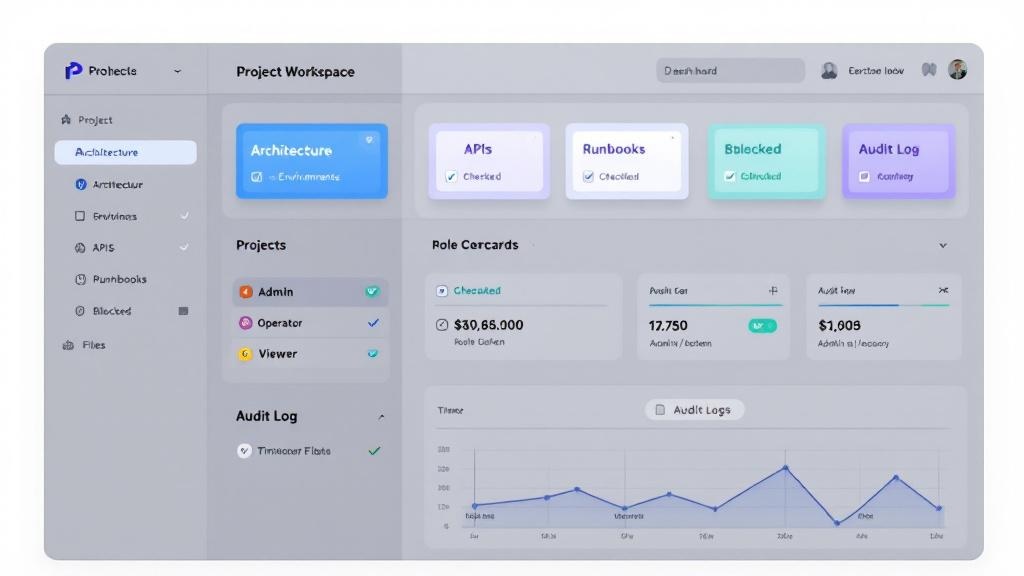
Continuity survives vendor rotation when you standardize three governance patterns: role-based access, decision traceability, and durable archives. First, implement access governance with roles (e.g., Client Admin, Vendor Operator, Auditor/Viewer) and make secrets shareable and revocable without reissuing everything. Pair that with auditing—who viewed, changed, or exported credentials—so you can prove control during incident review or compliance checks.
Second, maintain a lightweight decision log: key architectural choices, constraints, rejected options, and “why this exists.” New teams don’t just need the what; they need the reasoning to avoid repeating debates or breaking assumptions. Third, create a handoff archive that’s independent of any one vendor’s tool preferences: final links, environment URLs, deploy steps, monitoring, warranty terms, and a map of where ongoing work lives (tickets, invoices, repos). Tools like HandoffVault Workspace operationalize this with template-based sections, checklist gating before “handoff complete,” and vaulted access with audit trails—then export to PDF/ZIP so the record outlives any system.
Day-one onboarding for the next vendor—without replatforming

To onboard a new vendor safely on day one, run a “handoff-first” kickoff: grant least-privilege access, review the handoff agenda, and confirm operational readiness before any code changes. Start with Viewer access to the archive and decision log, then escalate to Operator access only for the environments they own. This approach reduces risk while preserving velocity—an essential balance for client operations teams who inherit production responsibilities.
Next, validate the basics in a structured walkthrough: how to deploy, where secrets live, what monitoring alerts mean, and what “good” looks like in production. Checklist gating helps here by making missing items obvious (DNS records, monitoring links, renewal dates, warranty terms), preventing the common trap of “we’ll fill that in later.” Finally, export a stable snapshot (PDF/ZIP) for internal records and procurement continuity, and keep the workspace as the living hub for updates—especially when vendors rotate again. With the right IT governance and continuity planning, your stack stays stable even when your suppliers change.